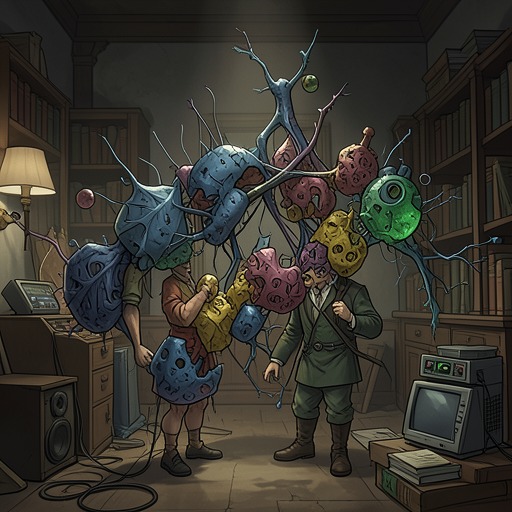
Stability Survivor
The Selfish GeneSurvival of the stable is the book’s broadest account of how order can accumulate without design: stable patterns persist, and once replicators arise, their differential persistence becomes natural selection. The concept connects physical stability to biological evolution while keeping purpose out of the explanation; what survives does so because of its properties and circumstances, not because it wants to.
From physical stability to selection
The argument begins with a distinction between survival of the fittest and the more general survival of the stable. A stable thing may be a particular structure that lasts, such as the Matterhorn, or a kind of thing that is continually produced, such as raindrops. Rocks, galaxies, and ocean waves are all patterns of atoms with differing degrees of stability. Their persistence does not require a plan: a soap bubble tends toward a sphere, water in a spacecraft forms globules, and standing water on Earth settles into a flat surface under gravity because those forms are stable under their respective conditions.
The same principle applies to chemical structures. Salt forms crystals because sodium and chloride ions pack into a stable arrangement; in the Sun, hydrogen fuses into helium because helium is more stable under the conditions there. More complex elements formed in stars, supplying the material from which worlds are made. Molecules, too, vary in stability. A diamond crystal can be regarded as a simple, repeating molecule, whereas haemoglobin illustrates a highly complex but still definite structure: its 574 amino-acid molecules form four chains that twist into a particular three-dimensional shape. The example makes stability visible at very different scales, from repeated crystal structure to intricate protein form.
The threshold of natural selection
Before life, the book proposes, ordinary physical and chemical processes could already produce a rudimentary sorting among molecular forms. When atoms joined into a stable pattern in the presence of energy, that pattern tended to remain; unstable arrangements did not. In this limited sense, the earliest selection was simply the persistence of stable forms and the disappearance of unstable ones. It required neither design nor direction.
This physical sorting is not offered as a complete explanation for complex organisms. Randomly combining the atoms needed for a human being would not plausibly produce one, even given immense time. The account instead marks a transition: the stability of molecules provides a starting point, while Darwinian natural selection explains how evolution can continue from there. The proposed origin-of-life story is necessarily speculative, since nobody witnessed it, but the book emphasizes that rival accounts share some features.
Replicators and evolving stability
Once replicator molecules are introduced, stability takes on three evolutionary forms: longevity, fecundity, and copying fidelity. A molecule may persist because individual copies last a long time, because it makes copies rapidly, or because those copies are accurate. Over time, the primeval soup would contain a greater proportion of varieties strong in one or more of these properties. This change in the composition of the population is evolution by natural selection, operating through the same general principle of differential persistence.
The account does not depend on whether these early molecules count as living. The label is less important than their role: regardless of terminology, they were ancestors of life. Likewise, evolution does not occur because anything wants it to. Copying errors make evolutionary change possible, even though selection favors copying fidelity; these are compatible consequences of the same process, not signs of intention.
From molecules to genes and adaptations
The stable patterns that matter in modern evolution are not isolated, self-sufficient agents. A survival machine contains many thousands of genes, whose effects interact in development. Genes cooperate in building bodies, and the influence of any one gene depends on other genes and the environment. Sexual reproduction continually reshuffles combinations: individual bodies are temporary arrangements, while genes can persist through successive bodies over many generations. The book therefore treats a gene as a replicator whose copies can endure, rather than as an entire organism or an independent builder.
That perspective also qualifies claims about adaptation. A caddisfly’s house can be understood as an adaptation if ancestral genes influenced differences in house-building and natural selection favored the versions associated with effective houses. The genes act through development and behavior; their effects become visible in the form of the structure. The house is not itself a gene, and the genetic influence is indirect, but hereditary variation is necessary for selection to produce an adaptation.
Scope and limits of the principle
The same discipline applies to behavior. An individual act that looks altruistic does not, by itself, establish why it evolved; illustrative stories are not serious evidence for a general theory. The book argues that explanations must track the level at which selection changes frequencies. A behavior can evolve only if genes influencing its development survive more successfully than alternatives, even when the resulting behavior appears self-sacrificing at the level of an individual animal.
This framework also distinguishes a plausible story from adequate evidence. The proposed population-regulation account associated with Wynne-Edwards may seem convincing, but examples compatible with it can also fit explanations based on gene-level selection. Survival of the stable is thus not a license to assign a purpose to every persistent feature. It is a way to frame the question: what variation is inherited, what conditions affect persistence or replication, and which alternatives become more common? The principle’s reach extends from atoms to evolving genes, but each specific adaptation or behavior still needs evidence for its particular causal history.